Pressure-regulated hydrant mist canopy · v0.3 concept

A palm tree for every hydrant.

New York already opens hydrants in heat waves — 1,000 gallons a minute, pressure drops, DEP warnings. Mr. Palm Tree crowns the hydrant instead: a 3D-printed palm that mists a 20-foot canopy on 2% of a spray cap's water, shades the sidewalk, and lifts off in 15 seconds when FDNY needs the hydrant.

0.25 GPM
water use
32 kW
latent cooling
<15 s
FDNY liftoff
~$350
unit BOM
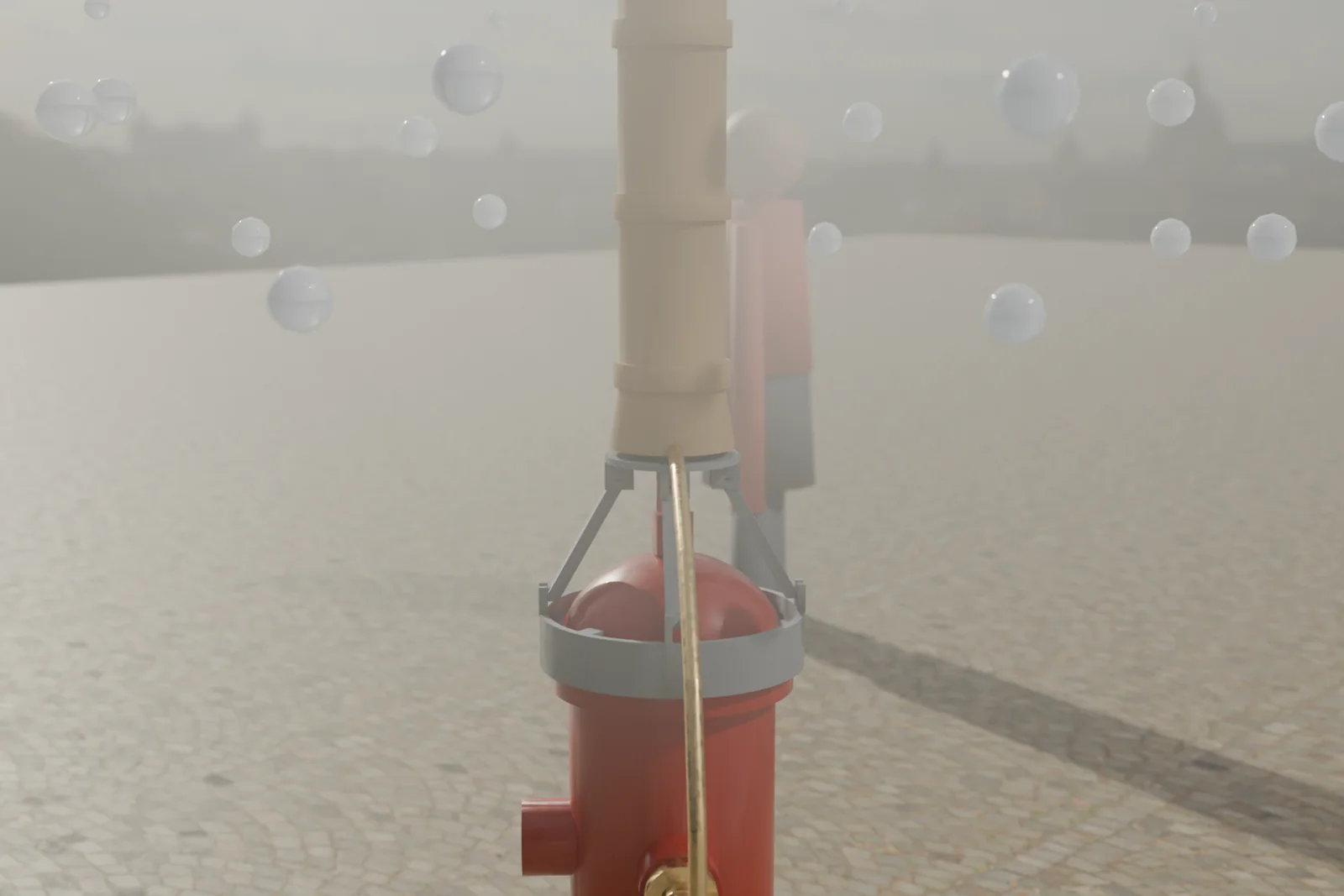
Render of the palm mister mounted on a NYC fire hydrant
CAD render · top-mount on the bonnet · nozzle ring at ~10 ft
01
The system

Three rules make it deployable

Every design decision serves the one constraint that matters: a fire hydrant must stay a fire hydrant. The tree is a guest on FDNY's hardware.

RULE 1

Print carries form, brass carries force

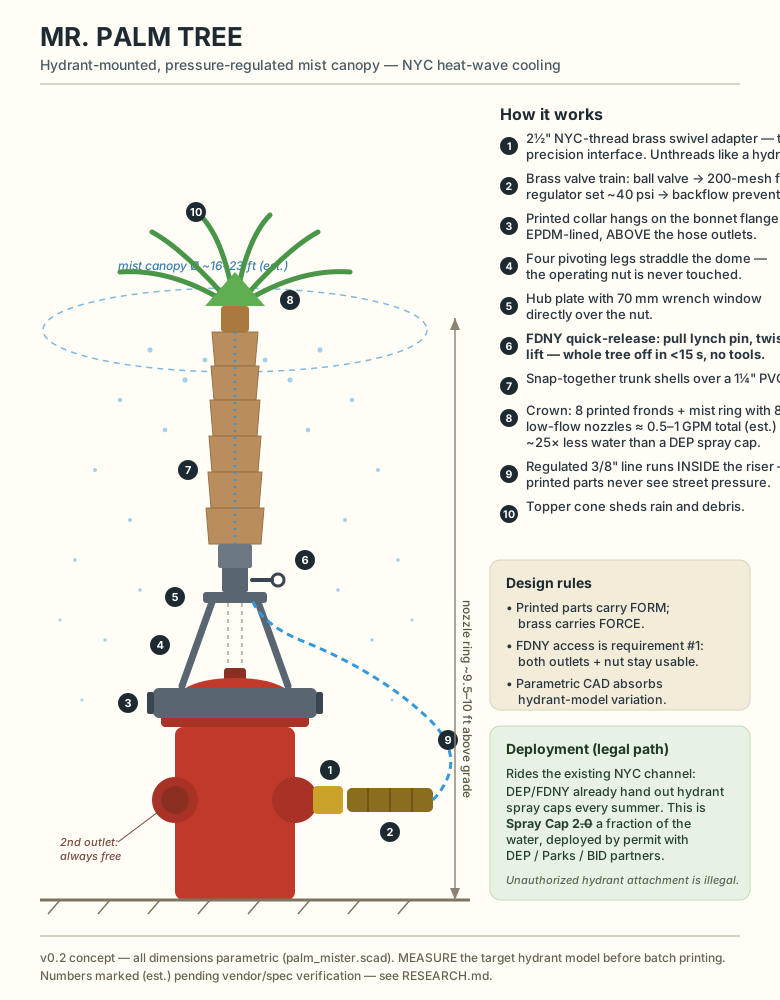
Street pressure (30–90 psi, verified) lives in off-the-shelf brass at the outlet: swivel adapter → ball valve → 200-mesh filter → regulator at 40 psi → backflow preventer. The regulated line runs inside the structural riser. A printed part failing is a dribble, not shrapnel.

RULE 2

FDNY access is requirement #1

The collar hangs on the bonnet flange above both hose outlets. The operating nut sits under a 70 mm wrench window. Pull one lynch pin, twist 25°, lift — the whole tree is off in under 15 seconds, no tools. Our feed unthreads like any hydrant cap.

RULE 3

Parametric everything

NYC runs several hydrant castings across eras. Every dimension is a parameter in one OpenSCAD file; the only precision interface — the 2.5" New York Corporation thread — is a purchased brass part, never printed. EPDM foam absorbs the rest.

02
Virtual test bench

Test it before a single part prints

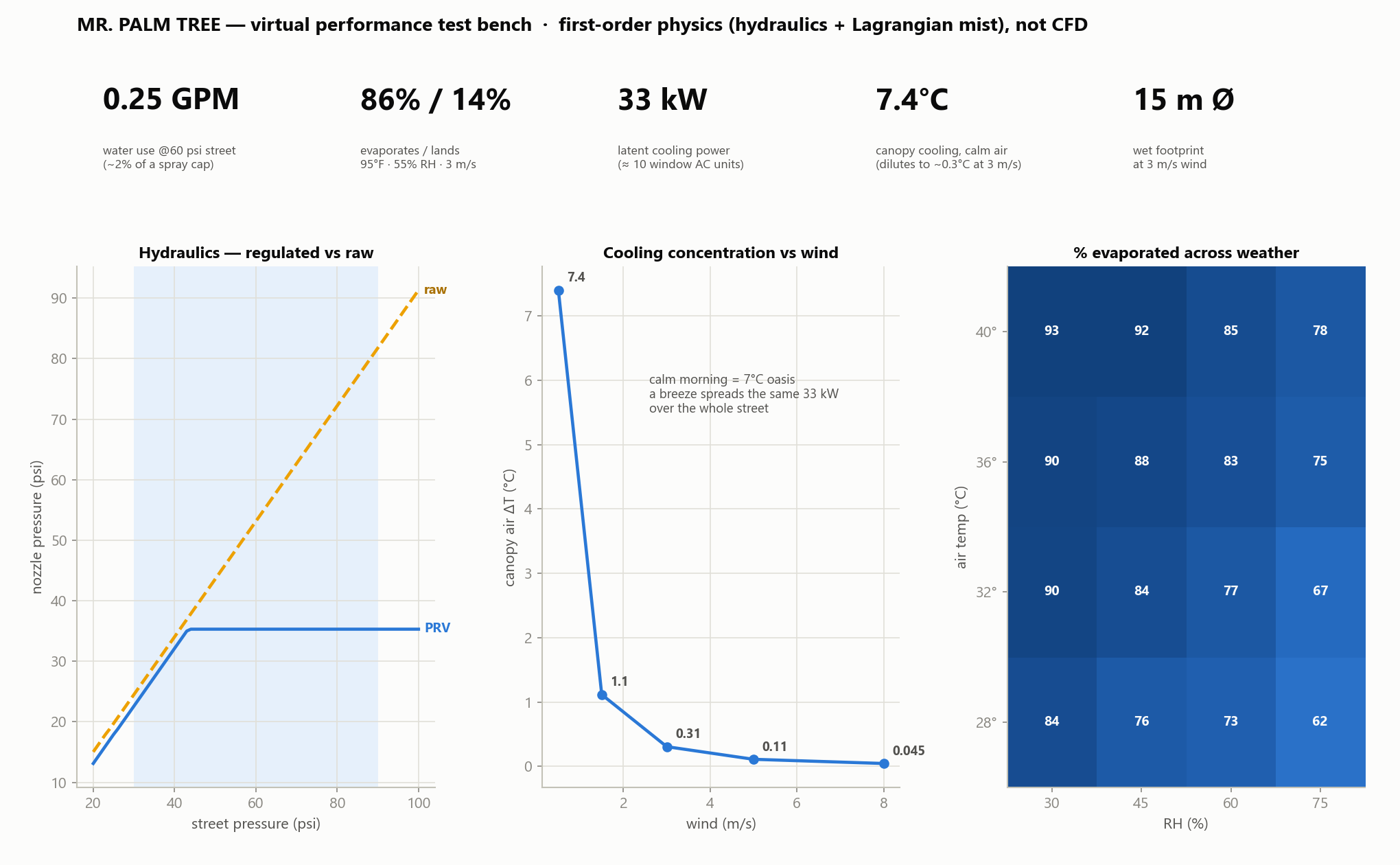
A physics test bench runs the whole system virtually: self-consistent hydraulics from street main to nozzle ring, and a Lagrangian droplet simulation — drag, evaporation, gusty urban wind — for the mist itself. First-order engineering physics, honestly labeled (not CFD), field-calibrated by design.

Live simulator

Drag street pressure, wind, temperature, and humidity. Watch a few thousand droplets respond in real time — and watch the readouts: nozzle pressure, flow, evaporate/land split, latent kilowatts, canopy ΔT, wet footprint.

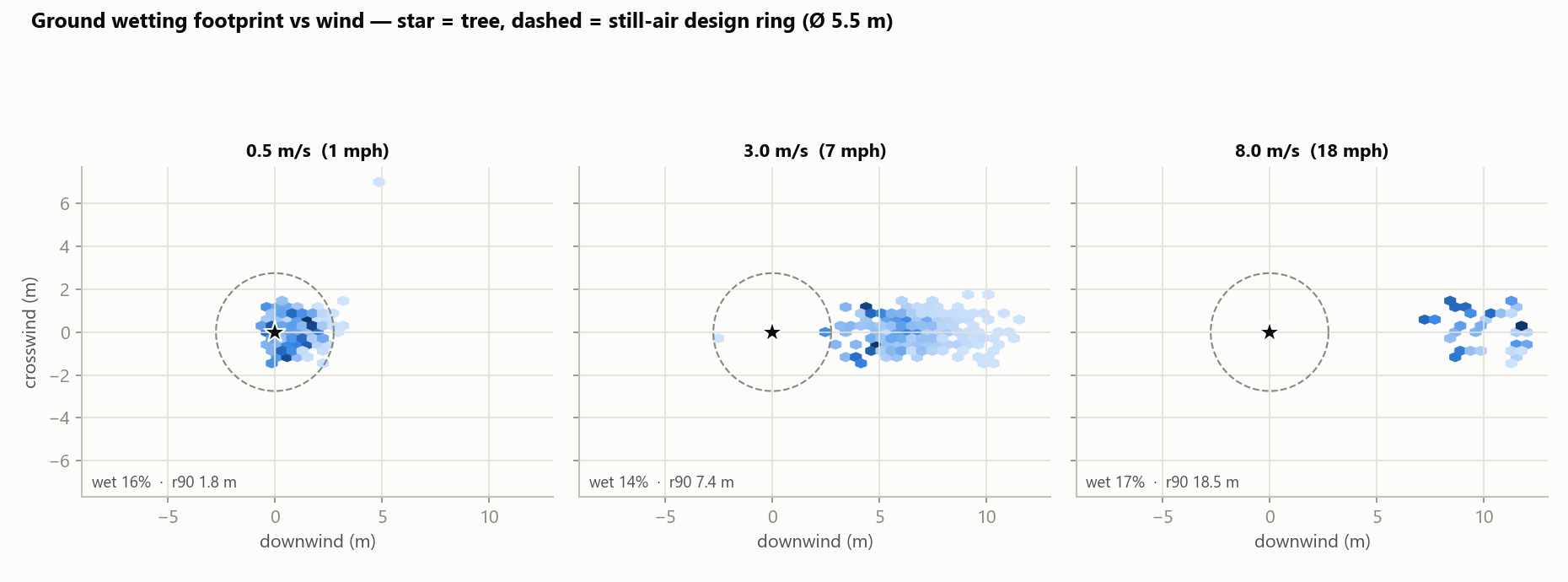
TRY: wind 0.5 → ~7°C oasis under the canopy · wind 8.0 → same 32 kW spread down the block
Open the test bench →
Performance dashboard from the Python test bench
03
Blueprint

How the water and the load move

One diagram carries the argument: the mount never blocks an outlet or the operating nut, printed parts never see street pressure, and the whole canopy rides the hydrant — the sturdiest anchored object on the block.

Labeled system schematic of the hydrant palm mister
System schematic — pressure chain, mount stack, FDNY quick-release
CAD walkthrough at true scale — shade crown build, 20 s
04
Assembly

One printer, one afternoon, one wrench

Fourteen printable parts (PETG for the body, ASA for the sun-baked load path — PLA is banned; it sags on exactly the day this matters) plus hardware-store brass and a 10-ft stick of PVC or aluminum. Full settings in the print guide below.

Print the sets

Mount set in ASA (collar ×2, legs ×4, hub plate, riser sleeve) — ~12 h. Decorative set in light-color PETG (trunk shells, fronds, crown). 0.6 mm nozzle, 0.3 mm layers.

Collar the bonnet

EPDM-lined halves bolt around the bonnet flange with four M5s — load bears on the casting shoulder, above both hose outlets. Line stays paint-safe.

Legs + hub plate

Four pivoting legs straddle the dome to the hub plate; clevis pivots self-align to any hydrant's dome angle. The 70 mm wrench window lands over the operating nut.

Build the tree

Riser sleeve screws to the pipe (feed notch aligned), trunk shells snap on in pairs, crown hub takes eight fronds, mist ring, and topper.

Drop, twist, pin

Tree drops into the bayonet socket, twists 25°, lynch pin locks it. That pin is the FDNY quick-release — and the printed lugs are the designed sacrificial fuse.

Plumb and mist

Flush the hydrant 30 s → swivel adapter → valve → filter → regulator at 40 psi → backflow preventer → feed line up the riser. Open the valve (permit holder only) — mist on.

FDNY removal drill — printed on every unit's collar tag

Pull lynch pin → twist tree 25° → lift off (<15 seconds, no tools). Wrench passes through the hub window onto the nut. Our feed adapter unthreads like a hydrant cap. Both outlets were never blocked to begin with.

05
Performance

The numbers, with their sources

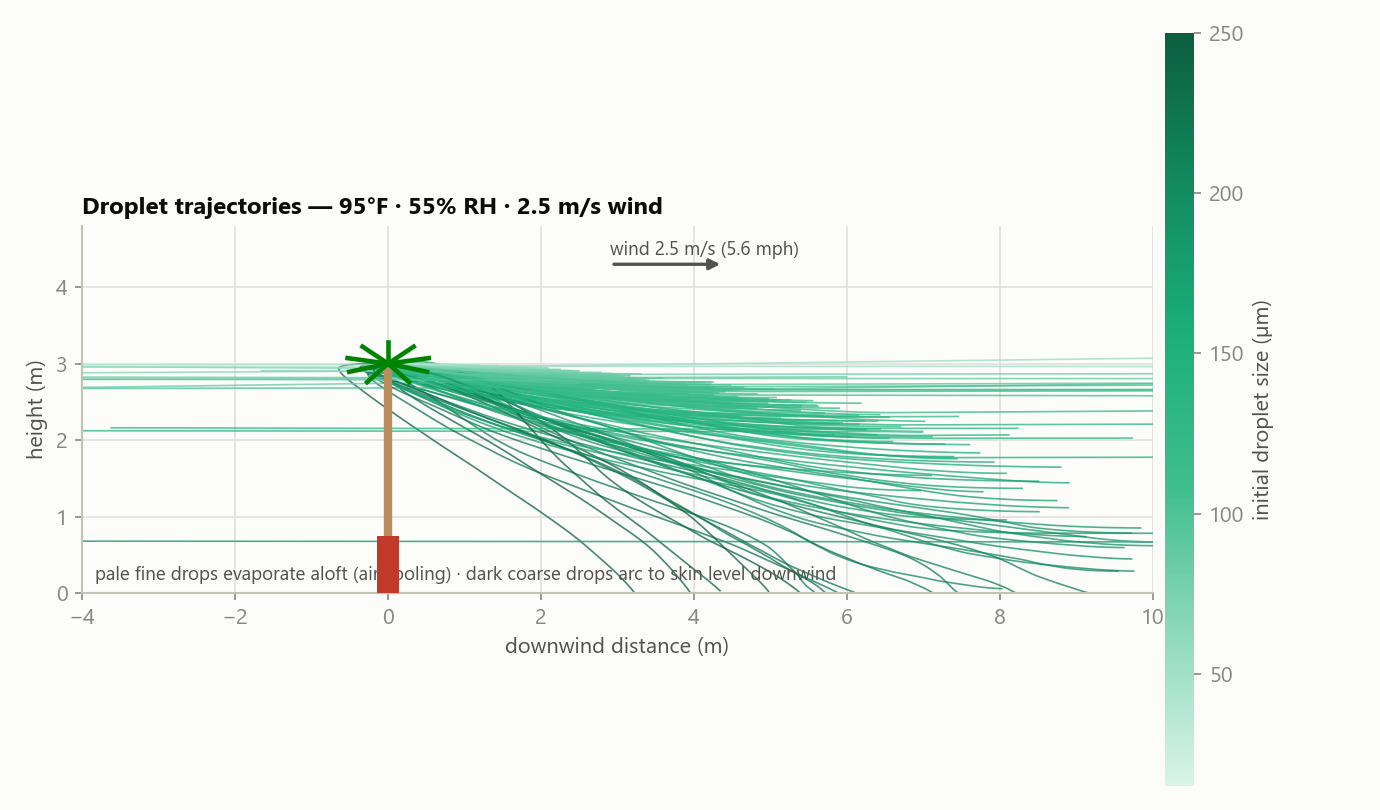
Simulated droplet trajectories by size
Droplet trajectories — fine drops cool the air aloft, coarse drops reach skin
Ground wetting footprint at three wind speeds
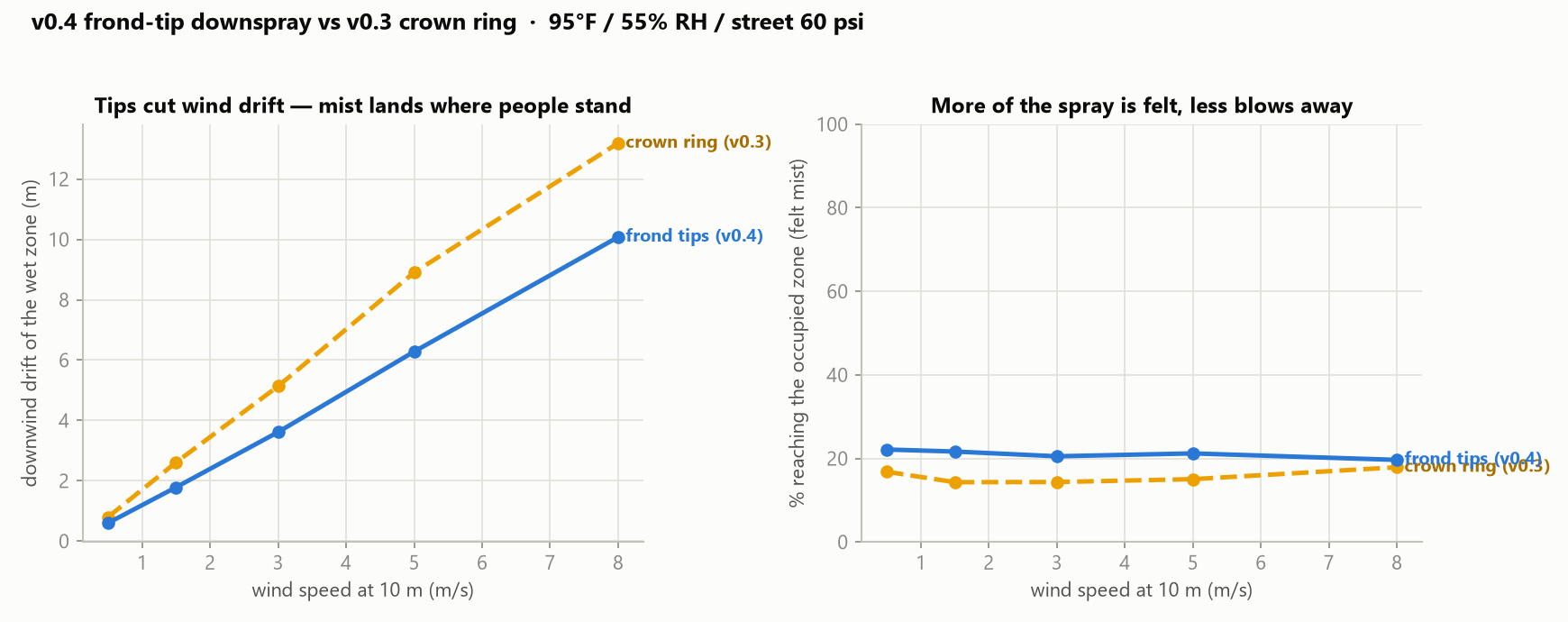
Wetting footprint vs wind — the 10 m downwind siting rule, visualized
ClaimValueBasis
Water use (street 30–90 psi, regulated)0.20–0.25 GPM[SIM] hydraulics solve, flat across the verified band
DEP spray cap, for comparison20–25 GPM[VERIFIED] NYC DEP
Illegally opened hydrant1,000+ GPM[VERIFIED] NYC DEP
Latent cooling power~32 kW (≈10 window ACs)[SIM] evaporated mass × latent heat
Spray that evaporates in NYC heat-wave air83–85%[SIM] 95°F · 55% RH; 62% even at 75% RH
Canopy cooling, calm air6–7°C[SIM] mixed-box; dilutes <0.5°C above 3 m/s wind
Street main pressure, NYC30–90 psi[VERIFIED] location/time dependent
Hydrant thread2.5" New York Corporation (not NST)[VERIFIED] buy the brass adapter, never print threads

[SIM] = first-order physics bench (sim/mist_sim.py), constants field-calibrated via the catch-cup protocol before any number goes in a contract. [VERIFIED] = sourced in the project research file.

06
Open hardware

Build files

The whole design is parametric OpenSCAD — measure your hydrant, set four numbers, export. STLs below are the v0.3 defaults (placeholder hydrant dimensions; test-fit before batch printing).

07
Procurement

Spray Cap 2.0 — sold the way NYC already buys

The city already sanctions hydrant cooling: FDNY firehouses hand out spray caps every summer, and NYC Parks' Cool It! program is actively adding cooling elements — including hydrants adapted as misting features. Mr. Palm Tree productizes the city's own program line, at 2% of the water.

BuyerWhy themSpeed
Business Improvement DistrictsPrivate budgets, control plazas, love photogenic amenities — pilot under a DEP hydrant-use permitDays–weeks
NYC ParksCool It! NYC already adapts hydrants into misting features — this is shovel-ready product for their lineWeeks
NYC DEPOwns street hydrants + the spray-cap program; the water math is their headlineMonths
Council / Participatory BudgetingVisible, district-level, equity-mappable cooling (Heat Vulnerability Index targeting)Budget cycle
NYCEM heat emergenciesEmergency procurement moves fast when a heat emergency is declared — be pre-piloted and pre-pricedEvent-driven

A pilot pack — three trees, install, removal, season maintenance, and a data report — prices under NYC's $20,000 micro-purchase line: an agency can buy it with a signature, no competitive bid. Request the pilot pack →